
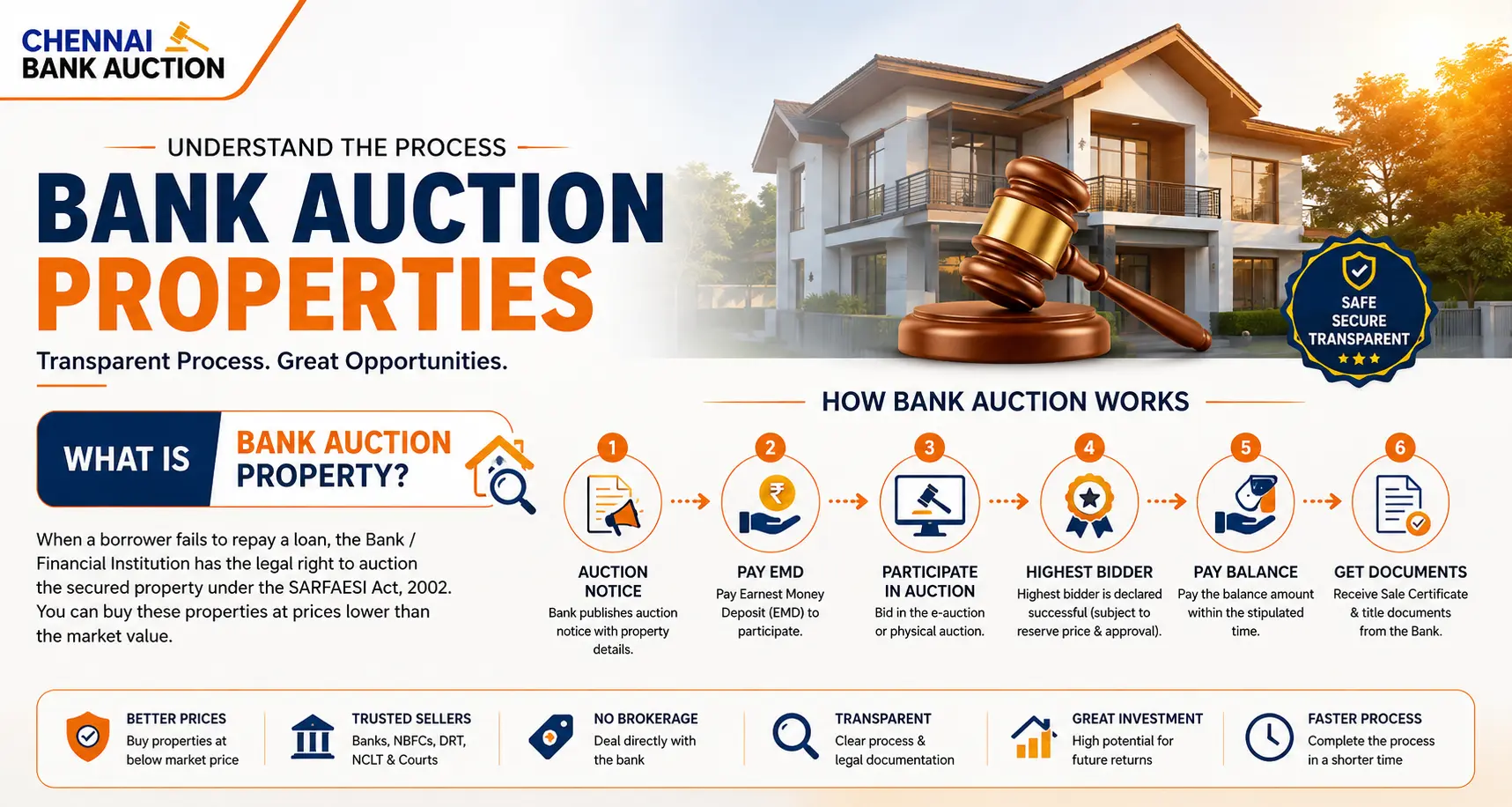
What is a Bank Auction Property?
A Bank Auction Property is a property that has been mortgaged to a Bank, Financial Institution, NBFC, ARC (Asset Reconstruction Company), DRT (Debt Recovery Tribunal), NCLT (National Company Law Tribunal), or Court. When the borrower fails to repay the loan as per the agreed terms, the lender has the legal right to recover the outstanding dues by auctioning the secured asset under applicable laws, including the SARFAESI Act, 2002.
At ChennaiBankAuction.com, we have been providing bank auction property information since 2010, helping buyers identify opportunities to purchase properties at prices that are often lower than prevailing market rates.
How Does a Bank Auction Work?
1. The lender publishes an auction sale notice with complete property details.
2. Interested buyers must submit the Earnest Money Deposit (EMD) before the auction date.
3. Eligible bidders participate in the e-auction or physical auction process.
4. The highest bidder, subject to the reserve price and lender approval, is declared the successful bidder.
5. The successful bidder must pay the required initial amount as specified in the sale notice.
6. The balance sale consideration must be paid within the timeline prescribed by the auction terms.
7. Upon receipt of the full payment, the lender issues a Sale Certificate and hands over the available title documents as per the auction conditions.
Advantages of Buying Bank Auction Properties
Significant Cost Savings
Properties may be available at prices lower than comparable market rates, creating attractive opportunities for homebuyers and investors.
Direct Purchase
Buyers can contact the concerned Bank or Institution directly and participate in the auction process without paying brokerage.
Transparent Process
Auction terms, reserve price, EMD requirements, and payment schedules are clearly specified in the auction notice.
Government-Regulated Process
The auction is conducted by authorized Banks, Financial Institutions, ARCs, DRTs, NCLTs, NBFCs, or Courts in accordance with applicable laws and regulations.
Investment Potential
Properties purchased below market value may offer long-term appreciation and investment opportunities.
Wide Range of Properties
Residential properties, commercial buildings, industrial assets, vacant lands, factories, apartments, and other asset classes are regularly auctioned.
Who Should Consider Bank Auction Properties?
- First-time homebuyers
- Real estate investors
- Property traders
- Business owners seeking commercial premises
- Buyers looking for value-based property purchases
Important Points to Remember
- The reserve price mentioned in the auction notice is not necessarily the final sale price. Competitive bidding may increase the final auction price.
- Buyers should independently verify legal, technical, and physical aspects of the property before participating.
- All payments are made through proper banking channels and are fully accountable.
- The Sale Certificate is issued by the auctioning authority upon successful completion of the transaction.
- Buyers should carefully read the auction sale notice and terms & conditions before bidding.
Payment Process and Auction Timeline
Step 1: Reserve Price Announcement
The Bank or Financial Institution fixes a Reserve Price (Base Price) for the property based on an approved valuation report. Bidding starts from this reserve price during the auction.
Step 2: Pay Earnest Money Deposit (EMD)
To participate in the auction, interested buyers must pay the prescribed EMD (Earnest Money Deposit) before the auction date. The EMD amount is usually mentioned in the auction sale notice and can be paid through RTGS, NEFT, or other approved banking methods.
Step 3: Participate in the Auction
On the auction date, eligible bidders can participate in the e-auction or physical auction and place bids above the reserve price.
Step 4: Successful Bidder Payment
If you become the highest bidder and the bid is accepted by the Bank, you must generally pay 25% of the sale consideration (including EMD) within the time specified in the sale notice, usually within 24 hours.
Step 5: Balance Payment
The remaining 75% of the sale consideration must be paid within the period specified by the Bank. Depending on the auction terms, this may range from 15 days to 3 months.
Step 6: Sale Certificate and Documents
After receiving the full payment, the Bank or Auctioning Authority will issue the Sale Certificate and provide the available title documents related to the property as per the auction terms and conditions.
Home Loan Assistance
In many cases, home loan assistance can be arranged for eligible buyers.
- Properties below ₹30 Lakhs: Loan eligibility may be available up to 90% (subject to lender approval).
- Properties above ₹30 Lakhs: Loan eligibility may be available up to 75% (subject to lender approval).
Loan approval depends on the buyer’s profile, property eligibility, and the lending institution’s policies.
Why Buyers Prefer Bank Auction Properties
✅ Properties may be available at prices 20% to 60% below prevailing market rates
✅ No brokerage or middlemen involved
✅ Transparent and regulated auction process
✅ Direct purchase from Banks, ARCs, NBFCs, DRTs, NCLTs, and Courts
✅ Suitable for homebuyers and investors
✅ Opportunity to acquire quality properties at competitive prices
Disclaimer
ChennaiBankAuction.com is an information provider and does not sell properties directly. Buyers are advised to perform their own due diligence and verify all property-related details with the concerned Bank, Financial Institution, ARC, DRT, NCLT, NBFC, or Court before participating in any auction.